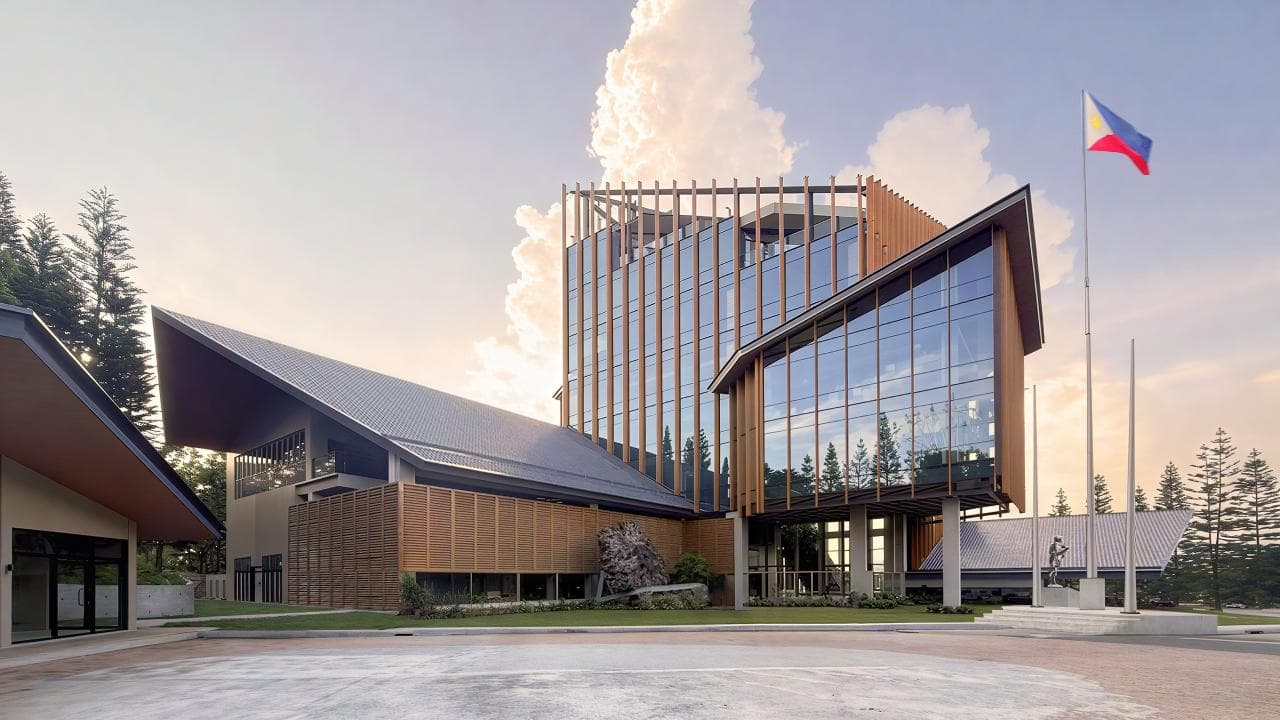
Tagaytay City Hall redefines civic architecture as an open, people-centered public realm rather than a distant institutional monument. Situated along Tagaytay’s volcanic ridge, the project responds directly to its terrain, climate, and views through a porous, campus-like composition of interconnected volumes. This strategy replaces a singular formal structure with a network of civic spaces that feel accessible, intuitive, and deeply rooted in place.
Public-facing departments are positioned at the most accessible lower levels, while administrative functions are elevated to enhance efficiency without losing visual connection to the public realm. Natural ventilation, daylighting, and shaded outdoor circulation allow the building to operate in harmony with the environment, reducing reliance on mechanical systems.
Beyond functionality, the project transforms governance into a more human experience. Open courtyards, walkways, and communal spaces extend its role into a social and cultural hub, encouraging interaction and civic engagement. By combining operational efficiency, environmental responsiveness, and spatial clarity, Tagaytay City Hall establishes a new benchmark for civic design that prioritizes accessibility, transparency, and a meaningful connection between people, government, and place.